
01 - Aleppo pine (Pinus halepensis)
Found from sea level all the way up to our mountain ranges, this is the most abundant and widespread forest tree in our region, accounting for 80% of woodland. The Pino de las Águilas (Eagle Pine) in Campo de Cagitán (Mula) is one of the oldest, most famous trees due to the trunk's girth measuring 6.41 metres, making it the thickest (and oldest) in the world. This fragrant conifer will line many of your walks through our natural areas and ecotourism destinations, filling the air with its distinctive scent.
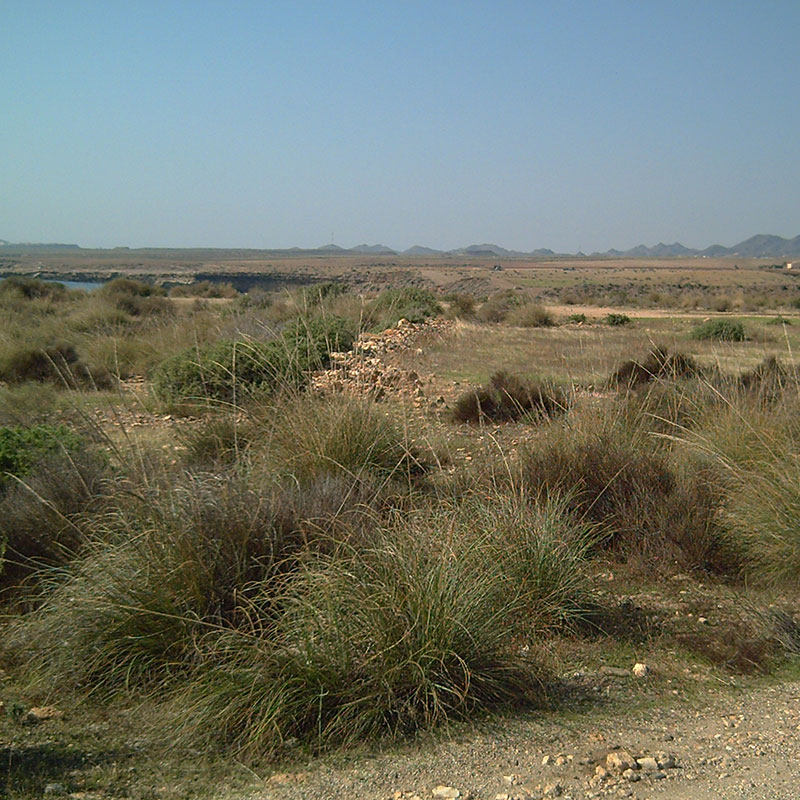
02 - Esparto (Macrochloa tenacissima)
This grassy plant is typical of steppe environments. It's a native plant that once played a key role in local crafts, used to make all kinds of equipment. You'll find it in the south of the province and in warm area in the northwest. You can learn more about this plant at the Esparto Museum in Cieza. The Spartaria project aims to combat forest neglect by adapting forest cover for the use of resources and environmental restoration, promoting diversification and ensuring year-round economic viability.
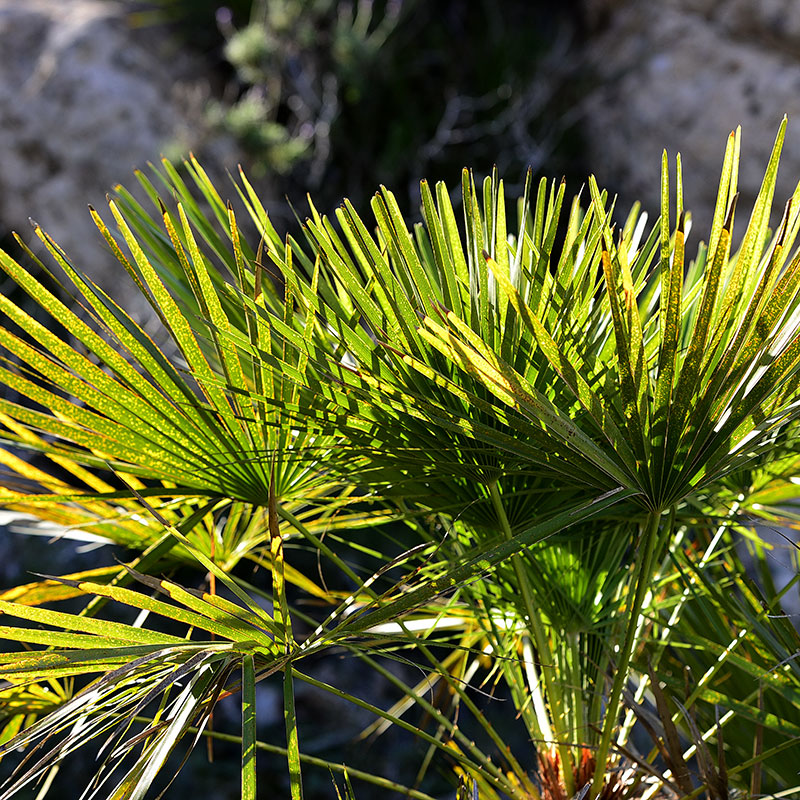
03 - European fan palm (Chamaerops humilis)
This is the only palm native to the Iberian Peninsula. It can be found extensively throughout the Region of Murcia, especially in coastal and arid areas, where it grows along almost every ecotourism route in Calblanque or La Muela-Cabo Tiñoso. It forms thickets known as palm groves and rarely grows above 4 metres tall. The fan palm has traditionally been used to make equipment such as baskets and brooms, and its buds are edible.

04 - Cartagena cypress (Tetraclinis articulata)
The Cartagena cypress grows only in Malta and Spain. In our country, the only wild populations are found in the Region of Murcia, specifically in the Calblanque Regional Park. A monumental tree can be found in the Sierra Espuña Regional Park (Sabina de Huerta Espuña), planted almost 150 years ago. It's around 20 metres tall and 2.2 metres in diameter. This is the largest in existence.

05 - Spanish juniper (Juniperus thurifera)
This evergreen tree is highly valued for its quality fragrant wood. Endemic to the Iberian Peninsula, it can be found in the limestone mountain moorlands; in our region, it grows in small woods in Caravaca and Moratalla. In the latter, specifically in the village of El Sabinar, there's a major cluster of Spanish juniper, one of the most southerly in Europe. Moratalla is also home to a monumental tree called the Martín Herrero Juniper. It's 13.5 metres tall and the trunk's girth is 5.5 metres far from small!

06 - Mediterranean juniper (Juniperus phoenicia subsp. turbinata)
This generally shrubby conifer grows among dunes and coastal sands in the western Mediterranean, south and east of the Iberian Peninsula and the Balearic Islands. In the Region of Murcia there were only 11 trees of natural origin left in the 20th century (San Pedro del Pinatar), but thanks to repopulation efforts carried out in recent decades, it has now recovered. Fancy seeing it? The Salinas y Arenales de San Pedro del Pinatar Regional Park and the nearby area of Las Amoladeras are the places to visit.

07 - Strawberry tree (Arbutus unedo)
Shrub/small tree that tends not to grow above 7 metres high. This is a strange species, as its branches bear flowers and fruit at the same time. When ripe in late autumn, its fleshy, rounded fruit takes on a striking reddish colour, and is enjoyed by many different animals. It typically grows among humid inland holm oak and kermes oak groves, although it can also appear in the undergrowth of pine forests. Key populations are found in the Sierra de la Pila Regional Park and in the Sierra de Ricote.

08 - Tamarisk (Tamarix subsp.)
Our region is home to several species of tamarisk, which are highly characteristic of local riverside habitats. It usually grows alone or in small groups, forming tamarisk groves in salt marshes and salty dry riverbeds. In its natural form, it grows as a densely branched shrub, although in the Campo de Cartagena, human intervention has transformed it into a tree. The Lo Santero Tamarisk (Torre-Pacheco) has a trunk measuring 5.2 metres in girth, which is quite extraordinary for Spain. Monumental tamarisks can also be seen in the Ajauque y Rambla Salada wetland.
01 - Aleppo pine (Pinus halepensis)
Found from sea level all the way up to our mountain ranges, this is the most abundant and widespread forest tree in our region, accounting for 80% of woodland. The Pino de las Águilas (Eagle Pine) in Campo de Cagitán (Mula) is one of the oldest, most famous trees due to the trunk's girth measuring 6.41 metres, making it the thickest (and oldest) in the world. This fragrant conifer will line many of your walks through our natural areas and ecotourism destinations, filling the air with its distinctive scent.
02 - Esparto (Macrochloa tenacissima)
This grassy plant is typical of steppe environments. It's a native plant that once played a key role in local crafts, used to make all kinds of equipment. You'll find it in the south of the province and in warm area in the northwest. You can learn more about this plant at the Esparto Museum in Cieza. The Spartaria project aims to combat forest neglect by adapting forest cover for the use of resources and environmental restoration, promoting diversification and ensuring year-round economic viability.
03 - European fan palm (Chamaerops humilis)
This is the only palm native to the Iberian Peninsula. It can be found extensively throughout the Region of Murcia, especially in coastal and arid areas, where it grows along almost every ecotourism route in Calblanque or La Muela-Cabo Tiñoso. It forms thickets known as palm groves and rarely grows above 4 metres tall. The fan palm has traditionally been used to make equipment such as baskets and brooms, and its buds are edible.
04 - Cartagena cypress (Tetraclinis articulata)
The Cartagena cypress grows only in Malta and Spain. In our country, the only wild populations are found in the Region of Murcia, specifically in the Calblanque Regional Park. A monumental tree can be found in the Sierra Espuña Regional Park (Sabina de Huerta Espuña), planted almost 150 years ago. It's around 20 metres tall and 2.2 metres in diameter. This is the largest in existence.
05 - Spanish juniper (Juniperus thurifera)
This evergreen tree is highly valued for its quality fragrant wood. Endemic to the Iberian Peninsula, it can be found in the limestone mountain moorlands; in our region, it grows in small woods in Caravaca and Moratalla. In the latter, specifically in the village of El Sabinar, there's a major cluster of Spanish juniper, one of the most southerly in Europe. Moratalla is also home to a monumental tree called the Martín Herrero Juniper. It's 13.5 metres tall and the trunk's girth is 5.5 metres far from small!
06 - Mediterranean juniper (Juniperus phoenicia subsp. turbinata)
This generally shrubby conifer grows among dunes and coastal sands in the western Mediterranean, south and east of the Iberian Peninsula and the Balearic Islands. In the Region of Murcia there were only 11 trees of natural origin left in the 20th century (San Pedro del Pinatar), but thanks to repopulation efforts carried out in recent decades, it has now recovered. Fancy seeing it? The Salinas y Arenales de San Pedro del Pinatar Regional Park and the nearby area of Las Amoladeras are the places to visit.
07 - Strawberry tree (Arbutus unedo)
Shrub/small tree that tends not to grow above 7 metres high. This is a strange species, as its branches bear flowers and fruit at the same time. When ripe in late autumn, its fleshy, rounded fruit takes on a striking reddish colour, and is enjoyed by many different animals. It typically grows among humid inland holm oak and kermes oak groves, although it can also appear in the undergrowth of pine forests. Key populations are found in the Sierra de la Pila Regional Park and in the Sierra de Ricote.
08 - Tamarisk (Tamarix subsp.)
Our region is home to several species of tamarisk, which are highly characteristic of local riverside habitats. It usually grows alone or in small groups, forming tamarisk groves in salt marshes and salty dry riverbeds. In its natural form, it grows as a densely branched shrub, although in the Campo de Cartagena, human intervention has transformed it into a tree. The Lo Santero Tamarisk (Torre-Pacheco) has a trunk measuring 5.2 metres in girth, which is quite extraordinary for Spain. Monumental tamarisks can also be seen in the Ajauque y Rambla Salada wetland.


